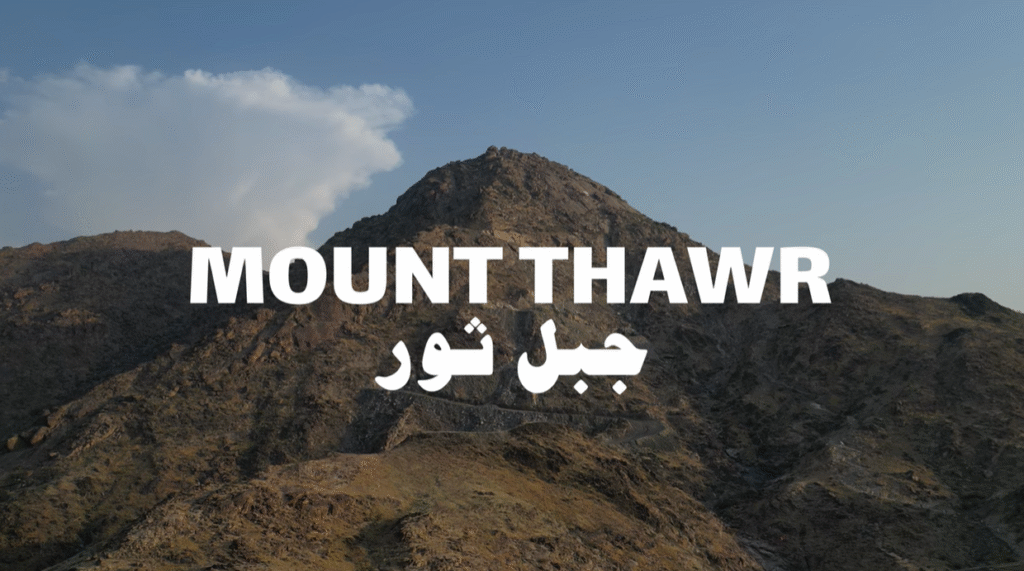
Imagine a moment of pure terror: you are pursued by enemies determined to end your life, with nowhere left to run. This intense moment of fear and salvation sets the scene for one of the most beloved and monumental events in Islamic history: the Prophet Muhammad’s ﷺ retreat into the Cave of Thawr.
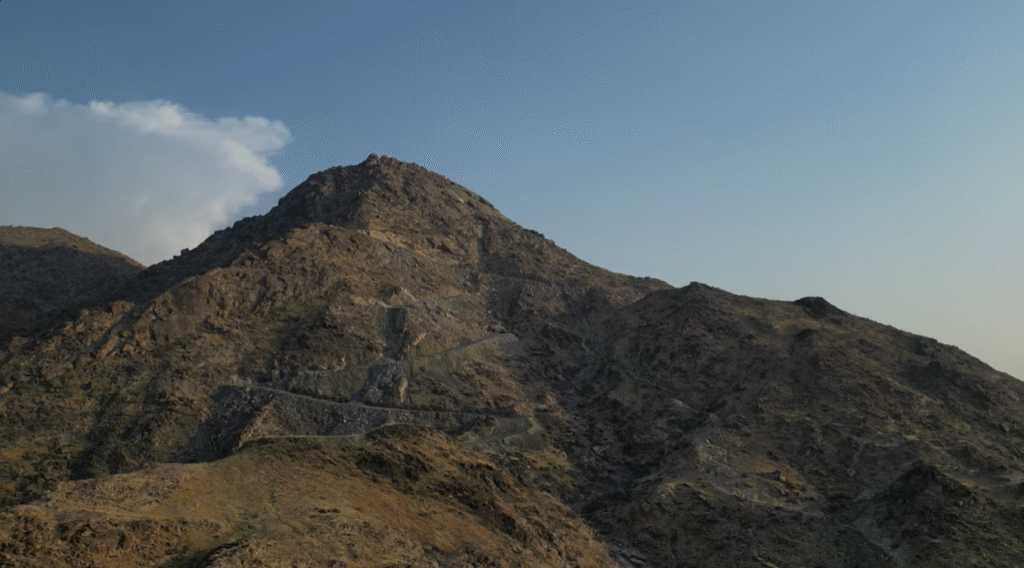
The story of Mount Thawr is not just history; it is a masterclass in faith and Tawakkul (unwavering trust in Allah). This blog complements our video, guiding readers through the dramatic history and the profound spiritual context of this sacred site in Makkah.
The journey to Mount Thawr was born out of necessity and divine command, marking the beginning of the great Hijra (migration) to Madinah.
The Prophet ﷺ and the nascent Muslim community faced relentless and intensifying persecution from the Quraysh leaders in Makkah. The situation culminated in a secret plot by the Quraysh to assassinate the Prophet ﷺ in his home.
As he prepared for the momentous and dangerous migration, his sole, trusted companion was Abu Bakr as-Siddiq (may Allah be pleased with him). Their bond and shared reliance on Allah would be tested immediately.
In a brilliant tactical move, they did not immediately head north toward Madinah. Instead, to confuse and deceive their pursuers, they traveled south—the opposite direction—leading them to the solitary heights of Mount Thawr, where they sought refuge.
The events that unfolded in the dark, silent cave demonstrate Allah’s immediate and miraculous protection.
After a difficult climb, reflecting the physical hardship and fear the two endured, they rested inside the small, rugged Cave of Thawr. They remained hidden there for three nights, while the Quraysh search party scoured the surrounding area.
The pursuers eventually reached the very mouth of the cave. In one of the most powerful miracles narrated in Islamic history, they were concealed by simple creatures:
The Quraysh leaders, seeing the untouched scene, concluded that no one could possibly have entered recently and moved on, unknowingly passing within inches of their target.
During this terrifying moment, Abu Bakr, fearing that if the pursuers simply looked down they would see them, whispered his worry. The Prophet ﷺ responded with the famous words of absolute conviction:
“What do you think of two when Allah is their third?”
Mount Thawr imparts lessons in faith, perseverance, and companionship that are timeless for every believer.
This is the enduring message of Mount Thawr. The Prophet ﷺ and Abu Bakr took all necessary means—traveling in the opposite direction, hiding in the cave—but their ultimate salvation came from their complete and unwavering reliance on Allah. Tawakkul means utilizing our best efforts and then leaving the outcome entirely to the Creator.
The three nights in the cave serve as undeniable proof of Abu Bakr’s immense status (Fadilah). He was chosen as the sole companion to share this critical, life-threatening moment, cementing his position as the most beloved and trusted confidant of the Prophet ﷺ.
The three days spent in the dark cave, enduring hunger and the constant threat of discovery, connect directly to the need for perseverance (Sabr) in the face of modern difficulty. Just as they waited for the clear path to emerge, we are reminded to be steadfast in our faith during times of trial.
For pilgrims, visiting Mount Thawr is a chance to walk the path of the Prophet ﷺ.
Climbing Mount Thawr is a demanding trek—steeper and generally longer than Mount Noor. Travelers must be prepared with plenty of water and proper equipment, especially since it is located further from the central Haram area. Be mindful of safety, particularly on the descent.
Crucial Point: While Mount Thawr holds immense historical weight, it is vital to remember that no specific ritual prayers or worship are prescribed at the cave. The visit should be one of remembrance, reflection on Tawakkul, and reading the historical accounts, avoiding any innovation (Bid’ah) that would turn the site into a place of prescribed worship.
If you wish to visit this and other sacred sites safely and with knowledgeable guides, allow us to arrange your pilgrimage journey:
Visit our website to arrange your guided trips
| Q1. | What happened at the Cave of Thawr? |
| A. | The Cave of Thawr is where the Prophet Muhammad ﷺ and his companion, Abu Bakr as-Siddiq (may Allah be pleased with him), sought refuge for three nights to escape the Quraysh during the critical period of the Hijra (migration) from Makkah to Madinah. |
| Q2. | What is the main spiritual lesson derived from this event? |
| A. | The main lesson is Tawakkul (unwavering reliance on Allah). The event shows that while the companions took all necessary physical precautions (taking the unusual route south), their ultimate safety came through miraculous divine intervention, proving the Prophet’s complete trust in Allah. |
| Q3. | What was the famous exchange between the Prophet ﷺ and Abu Bakr in the cave? |
| A. | When Abu Bakr expressed fear that the Quraysh searching outside would spot them, the Prophet ﷺ reassured him by saying, “What do you think of two when Allah is their third?” This quote symbolizes Allah’s protection and presence. |
| Q6. | How difficult is the climb to Mount Thawr? |
| A. | The climb to Mount Thawr is demanding, very steep, and generally more strenuous than the climb to Mount Noor. It requires good physical fitness and takes most people 1.5 to 2 hours one way. It is crucial to wear appropriate footwear and carry water. |
| Q7. | Is visiting Mount Thawr a part of the Hajj or Umrah rituals? |
| A. | No. Visiting Mount Thawr is considered a historical visit (Ziyarah) and is not a prescribed or recommended act of worship in Hajj or Umrah. The reward is for the remembrance, reflection, and the effort made, not for a specific ritual at the site. |
| Q8. | Are there any specific prayers or rituals to perform at the Cave of Thawr? |
| A. | No. There is no evidence in the Sunnah supporting specific prayers, touching the walls, or performing rituals inside the cave. The visit should be strictly for remembrance and reflection, avoiding any form of religious innovation (Bid’ah). |
| Q4. | What were the miracles that concealed the Prophet ﷺ and Abu Bakr? |
| A. | The miraculous concealment involved: A spider’s web spun across the mouth of the cave, and a dove’s nest with eggs laid near the entrance. These signs convinced the Quraysh that the cave had not been entered recently, causing them to turn away. |
| Q5. | Does the miracle in the Cave of Thawr have greater significance than the first revelation in the Cave of Hira? |
| A. | Both are immense. The Cave of Hira is the site of the beginning of revelation (the spiritual source of Islam). The Cave of Thawr is the site of divine protection and the perfection of Tawakkul, which allowed Islam to survive and spread. |
Mount Thawr’s enduring message is a comfort to all believers: fear not, for if Allah is with you, no enemy, no obstacle, and no threat can ultimately reach you. The story of the spider, the dove, and the two companions is a perpetual lesson in divine protection.
Dive deeper into the history and feel the power of this story! Watch the full video to see Mount Thawr differently and experience the site through our guided journey.
Follow us for more inspiring Islamic history and sacred site insights!